[category]
[title]
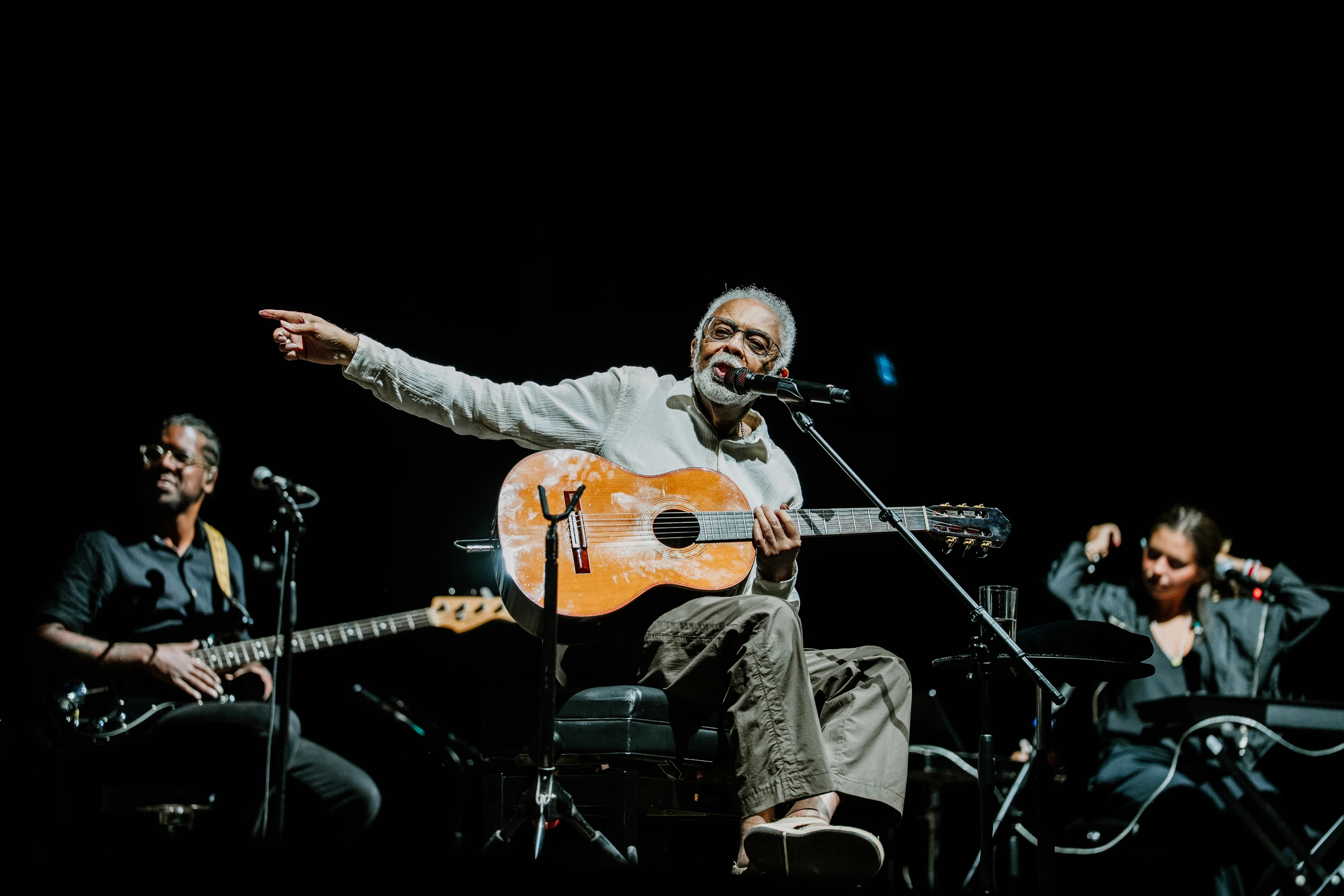
At the launch of AGEAS Cooljazz on 8 July, the Hipódromo Manuel Possolo surrendered to the living legend of Brazilian popular music. Gilberto Gil proved that, at 84 years old, he still knows how to organise a party.


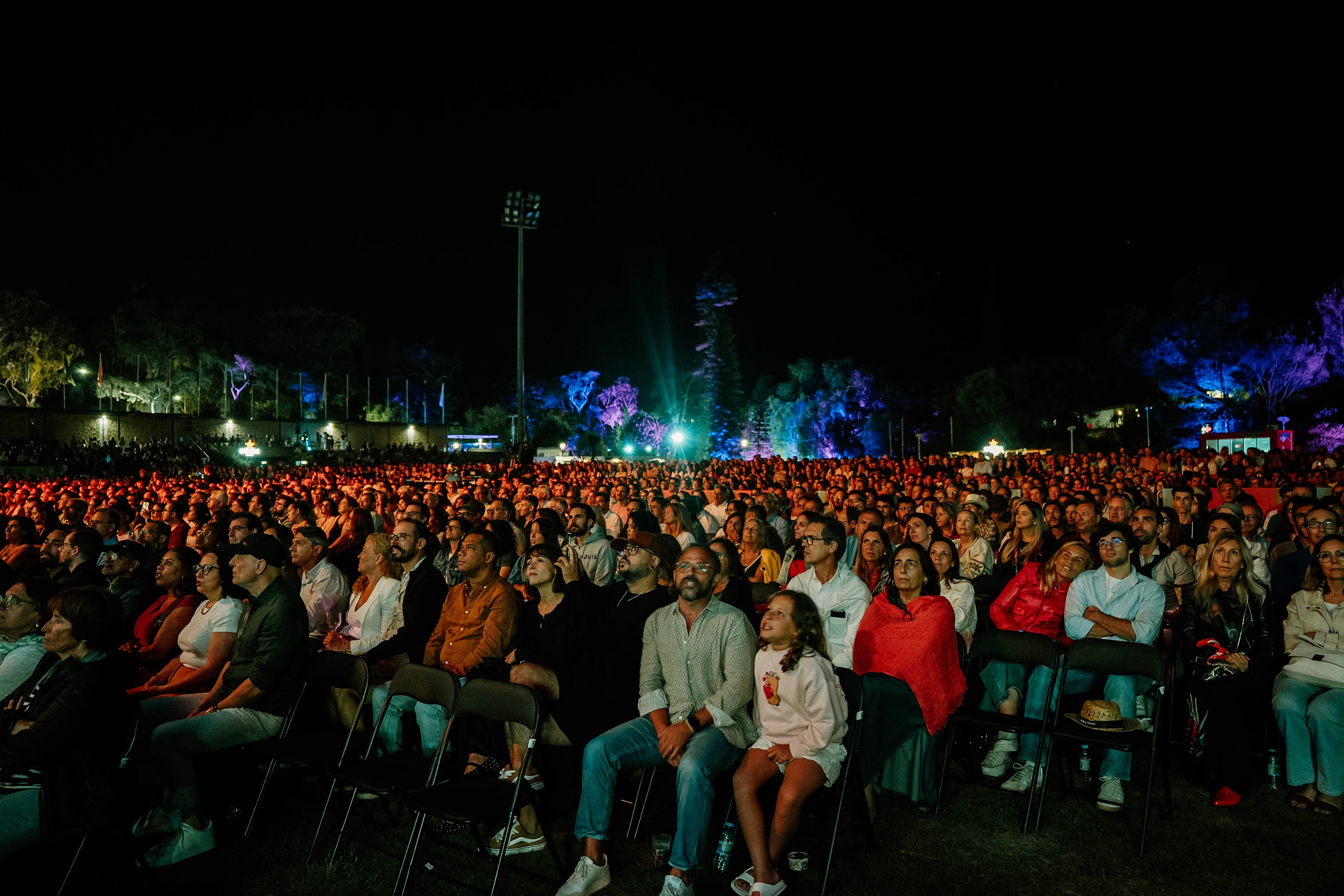
Let us start from the end. Gilberto Gil had not even finished the concert, which he starred in on the first day of AGEAS Cooljazz on 8 July, and the entire front row of the Hipódromo Manuel Possolo was already on its feet to bow to this legend of Brazilian popular music. Yes, it is true that many in the audience went to see the 84-year-old artist because they felt this might be their last opportunity to see him on stage. But the truth is, they stayed until the very end because he delivered a wonderful concert that got all of Cascais dancing, marking the opening of this edition of the Cascais festival with a roaring party.
When the singer (and former Brazilian Minister of Culture) took to the stage in a white shirt, sitting in his chair with the casual ease of someone sitting in a café among friends, silence fell. There is something profoundly magnetic about his figure: a mixture of an elder before whom all the youth fall silent to catch pearls of wisdom, but also a sweet grandfather who always has a funny story to tell (and in this case, to sing). He kicked off with "Expresso 2222" in a contagious samba rhythm that instantly got bodies moving. His voice, as became immediately clear, might falter at times or sound raspier, but that only adds more layers and authenticity to the music. Behind him, the band is not slow; rather, they are following the master in his own time and tempo.
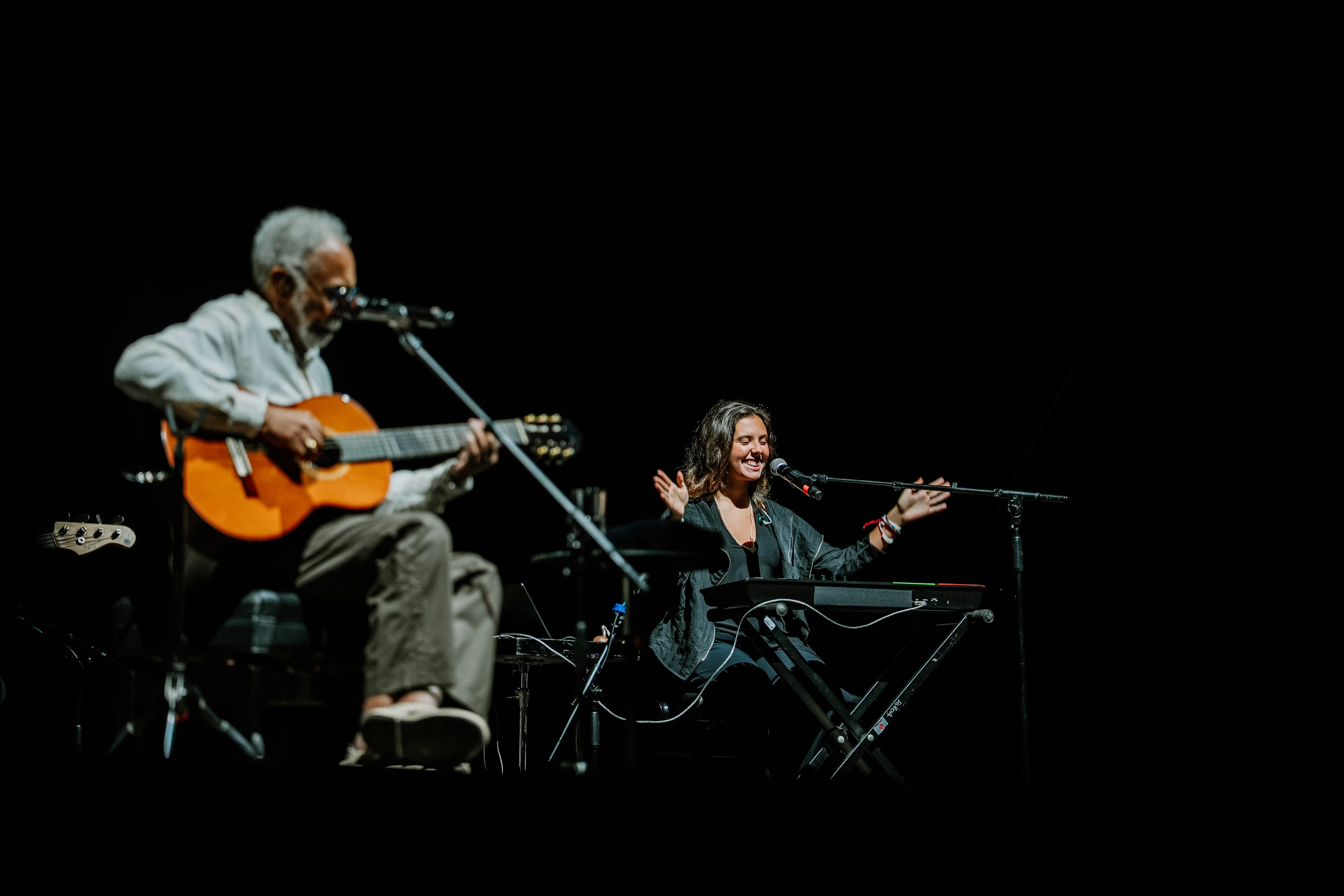
And what a band it is. Composed exclusively of members of his family, introduced after the performance of "Viramundo", it includes his sons Ben and José Gil, his grandson João Gil (the latter two also members of the band Gilsons), and his granddaughter Flor Gil, who frequently stole the spotlight during the show.
Gradually, the party came together. Gilberto may need to remain seated for most of the concert, but he proved he still has plenty of fire in his belly, receiving the audience's euphoria and happiness in return. "A very good evening, people of Cascais, and to the Brazilians too. To everyone who came, thank you for celebrating Brazilian song," the musician greeted.
The first part of the show was an ode to his country's identity and music, presenting various sambas and explaining the origin and meaning of each song. "Samba, as we all know, is a Brazilian rhythm and genre par excellence, representing the sensitivity and creativity of a people, and the various colours of the people," he explained, before launching into "Chiclete com Banana", a classic penned by Gordurinha and Almira Castilho, recorded by Jackson do Pandeiro, and "Upa, Neguinho", an Edu Lobo composition originally recorded by the late, missed Elis Regina, where the electric guitar stepped in to offer different shades to the arrangement.
There is plenty of history and stories to share, but let it not be thought that Gilberto Gil is a historian or a schoolteacher. He is a poet when he sings his own lines, and a painter when he breathes life and new colours into all these covers.
In one of the show's most emotional moments, Gilberto shared the origin of "Ladeira da Preguiça", a song written while he was exiled in the United Kingdom. "It was written by me when I lived in London. Times were very harsh in Brazil under the dictatorship," Gil recalled, with an audience member shouting back, "Fascism never again!" The artist continued: "Artists were persecuted, and Caetano [Veloso] and I ended up there. I wrote this song because I was homesick. It was hard to adapt to that life, but we managed to get by, and I wrote this." To the round of applause, he replied with a laugh: "I am just speaking of facts. The dictatorship is merciless," he concluded.
Despite the disrespect of some fans, who insisted on chatting and treating the concert as if it were an outdoor café terrace – a thank you to the person who called for silence in the middle of an especially noisy group, leaving a stillness where only Gilberto's story, the squawking of seagulls, and the drones flying over the venue could be heard – the music reminded us that there is also a party in political expression.
The concert continued with Ary Barroso's "É Luxo Só" — "a great author responsible for significant transformations in Brazilian popular song," he praised —, introduced by a beautiful drum solo by his son, José Gil. To close the cycle dedicated to samba, the classic "Garota de Ipanema" by Tom Jobim and Vinicius de Moraes was heard, featuring an unconventional version performed by "individuals from a more recent generation", which allowed Flor Gil to shine.
The energy shifted when Gil stood up from his chair and strapped on the electric guitar (well, electro-acoustic) for the first time to play "Palco", the irresistible hit from Luar (1981). It was the spark that caused the venue to explode. Everyone was singing, everyone was dancing, and making the absolute most of it. "Look at the Cascais choir!" the master challenged, watching the crowd sing the song back to him.
Before "Babá Alapalá", Gil made a point of bringing Brazilian ancestral heritage to the stage: "The Orixás, broad entities, complete in the sense of universal forces, arrived in Brazil when enslaved Black people arrived in the country, and there they fought to maintain their community and social strength, and their individual presence. The Orixás had and still have immense strength in Brazilian culture. We are going to dedicate a song to one of them, Xangô."
The final stretch was a succession of anthems loaded with emotion. In "Não Chore Mais (No Woman No Cry)", a Bob Marley cover, we experienced a beautiful moment of catharsis. There is something profoundly magical and healing about hearing an 84-year-old gentleman, who has lived, seen, and been through so much, singing with such feeling and truth that "everything is going to be alright".
The final cards played were the most energetic, forcing even the stubborn holdouts still sitting in the front row seats to stand up for good. "Aquele Abraço" followed, with couples dancing and singing the title line with vigour, arms in the air. In "Andar com Fé", the audience took the reins of the song and, after the madness of this performance, refused to let it end, continuing to sing a cappella, in unison, even after the instruments had stopped playing. There was still time for the British-inspired rock 'n' roll nostalgia of "Back In Bahia" – another great song about homesickness –, before the triumphant finale with "Toda Menina Baiana".
Although we were still a bit resentful towards the audience members who insisted on talking between songs, at that moment we had to give in and join the celebration. A dance circle opened up in the stalls, with everyone jumping and radiating pure happiness. The band took their bows at the centre of the stage, but the truth is, especially if this really was the last opportunity to see Gilberto, it is us who are grateful.
The festival continues on 14 July with David Byrne, former frontman of Talking Heads, as well as Bia Maria and Os Bardino.
Parque Marechal Carmona, Praceta Domingos D’Avilez Av. da República (Cascais). 8-31 July. €35-€75
More news: keep up with the latest news from Cascais
Discover Time Out original video